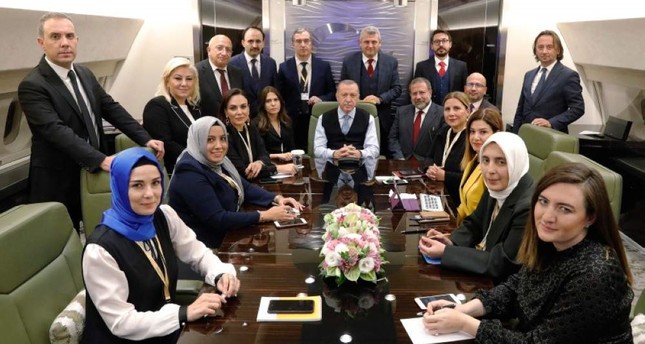
Turkey aims to set up the safe zone in northeastern Syria as soon as possible to facilitate the voluntary return of refugees with the support of international actors while it respects and upholds the territorial integrity of the country, President Recep Tayyip Erdoğan said late on Tuesday.
The president addressed reporters on his way back from Sochi after Turkey and Russia reached a groundbreaking deal to establish a safe zone in northern Syria. Under the scope of the deal, PKK terror group’s Syrian branch, the People’s Protection Units (YPG) terrorists, will retreat 30 kilometers within 150 hours starting at 12 noon on Oct. 23, followed by Turkish-Russian joint patrols in the area 10 kilometers into Syrian territory.
“Around 1 million people can be resettled in the area that will be made a ‘safe zone’ under the scope of Operation Peace Spring,” President Erdoğan said, adding that the number can reach 2 million with the inclusion of Raqqa and Deir el-Zour provinces.
However, the president noted that this is not something that Turkey can handle alone and the country needs international support.
“We worked out the costs, made necessary plans, and prepared our projects regarding the matter. We even presented booklets to some 17 leaders whom I talked to at the United Nations General Assembly,” Erdoğan said.
The president noted that Turkey expects this issue to be discussed at a meeting of international donors in Geneva, where the first meeting of the Syrian Constitutional Committee will be held on Oct. 29-30.
The Astana peace process – seeking to end the Syrian conflict once and for all and to facilitate U.N.-sponsored peace talks in Geneva – was launched in January 2017 upon the initiative of Turkey, Russia and Iran. The first meeting of the Astana process was held in Turkey in January 2017 to bring all warring parties in the Syrian conflict to the table to facilitate U.N.-sponsored peace talks in Geneva.
The Astana talks support the establishment of the U.N.-backed constitutional committee in Syria as part of finding a political solution. The constitutional committee – including representatives from the opposition, regime and guarantor countries – is tasked with writing and establishing Syria’s post-war constitution, which is seen as a stepping-stone to elections in the war-torn country.
Last month, a trilateral summit in Ankara between Turkey, Russia, and Iran, the fifth such meeting under the scope of the Astana talks, laid the foundation for a permanent solution in Syria by forming a constitutional committee. Then, the formation of a constitutional committee for Syria was announced.
“We want to establish residences, health facilities, schools and more to enable the return of Syrians,” the president added.
On Tuesday, Turkey and Russia reached a deal to establish a “terror-free zone” near the border. The two countries reached a 10-point agreement on Syria during the “historic” meeting between the two presidents just hours before the pause was set to expire.
According to the deal, Russian military police and Syrian border guards entered the Syrian side of the Turkish-Syrian border outside the area of Operation Peace Spring to facilitate the removal of YPG terrorists and their weapons to a location 30 kilometers beyond Turkey’s border in northern Syria, which should be finalized in 150 hours.
Russia supports Turkey’s involvement in Ayn al-Arab
Regarding the Syrian city of Ayn al-Arab, also known as Kobani, referred to as a so-called canton by the YPG, Erdoğan said Russia has always supported Turkey’s involvement, contrary to the U.S. stance. He criticized the Obama administration for dropping weapons, ammunition and other supplies to YPG terrorists there.
“If Turkey is hosting 350,000 people from Kobani, the Obama administration holds the main responsibility for this,” Erdoğan said, as he dismissed claims about Turkey not hosting and Kurdish refugees. He continued by saying that Turkey is also hosting Yazidi and other Syrian refugees and does not discriminate against any of the 3.6 million Syrians in the country.
The president highlighted that the Syrians are the real owners of the area and Turkey is only in the region to ensure this.
“We are not an army of occupation,” Erdoğan said, indicating that the Turkish military will leave after its job is done, referring to the Operation Peace Spring. Ayn al-Arab is also on Turkey’s agenda and will take care of the process in coordination with the Russians, the president added.
Turkey launched Operation Peace Spring, the third in a series of cross-border anti-terror operations in northern Syria targeting terrorists affiliated with Daesh and the YPG, on Oct. 9. The operation aimed to eliminate terrorists from northern Syria east of the Euphrates River in order to secure Turkey’s borders, aid in the safe return of Syrian refugees and ensure Syria’s territorial integrity.
The operation, conducted in line with the country’s right to self-defense borne out of international law and U.N. Security Council resolutions, aimed to establish a terror-free safe zone for Syrians return in the area east of the Euphrates River controlled by the U.S.-backed Syrian Democratic Forces (SDF), which is dominated by YPG terrorists.
On Oct. 17, a U.S. delegation led by Vice President Mike Pence paid a working visit to the Turkish capital, Ankara, where they met with President Recep Tayyip Erdoğan and discussed Turkey’s anti-terror operation.
Following the meeting, the two sides reached a 13-point agreement on northeastern Syria. As part of the deal, Turkey paused its anti-terror push east of the Euphrates for 120 hours to allow the withdrawal of the YPG from the planned safe zone. The pause ended Tuesday night.
Ankara and the U.S. agreed on a 32-kilometer safe zone south of the Turkish border in Syria, where Turkey wants to accommodate Syrian refugees it is currently hosting.
The PKK — listed as a terrorist organization by Turkey, the U.S. and the European Union — has waged a terror campaign against Turkey for more than 30 years, resulting in the deaths of nearly 40,000 people, including women, children and infants.
Turkey has long decried the threat from terrorists east of the Euphrates in northern Syria, pledging military action to prevent the formation of a “terrorist corridor” there.
Since 2016, Turkey’s Euphrates Shield and Olive Branch operations in northwestern Syria have liberated the region from YPG and Daesh terrorists, making it possible for nearly 400,000 Syrians who fled the violence to return home.
Turkey has no problems with Kurds
The president also expressed Turkey’s frustration about the term “Kurds” used by its allies to refer to YPG terrorists.
“Kurds this, Kurds that… We have no problems with the Kurds there. Our problem is only with YPG terrorists,” Erdoğan said, as he noted that both Russians and the Americans refer to YPG as Kurds.
“I both told U.S. and Russia that this is disrespectful to our Kurdish brothers and sisters. Please don’t use this. We are fighting against the PKK and YPG terrorists,” Erdoğan said and added: “It does not matter what race or religion the terrorist comes from. A terrorist is a terrorist.”
Erdoğan made reference to the Daesh terrorist group, saying that there are British, German, French and Dutch members of the group.
“Now when defining Daesh, which ethnicity should we highlight?” Erdoğan said, adding that it is not logical to include ethnicity when defining terrorists.
No change in Turkey’s plans if YPG fails to withdraw
The president noted that the deal between Turkey and Russia stipulates that the joint patrols will not be conducted in Qamishli because there are Russian and Assad regime soldiers there.
He said that Russian President Vladimir Putin expressed determination to ensure their withdrawal from the area.
“There are no changes in plans if the U.S. or Russia do not hold their promises as per the agreements,” Erdoğan said, highlighting that Turkey is determined to resume its operation if its allies fail to keep their word and the YPG fails to withdraw 30 kilometers to the south.
Erdoğan noted that he reminded Putin about the possibility that YPG terrorists may join the Assad regime army instead of withdrawing but the latter assured him that it would not happen.
“We will not let them,” Putin assured Erdoğan.
The article was previously published in dailysabah.com October 23, 2019